Publications & Preprints
across virtually all of machine learning, yet it treats all misclassifications equally, ignoring the semantic distances that a class
hierarchy encodes. We propose Hierarchy-Aware Cross-Entropy (HACE), a drop-in replacement for standard cross-entropy that
incorporates a known class hierarchy directly into the loss. HACE combines two components: prediction aggregation, which
propagates the model’s probability mass upward through the class hierarchy to ensure that parent nodes accumulate the confidence of their children; and ancestral label smoothing, which distributes the ground-truth signal along the path from the true class to the root. We evaluate HACE on CIFAR-100, FGVC Aircraft, and NABirds in two regimes: end-to-end training across six architectures spanning convolutional and attention-based designs, and linear probing on frozen DINOv2-Large features. In end-to-end training, HACE improves accuracy over standard cross-entropy in 15 out of 18 architecture–dataset pairs, with a mean gain of 4.66\%. In linear probing on frozen DINOv2-Large features, HACE outperforms all competing methods on all three datasets, with a mean improvement of 2.18\% over the next best baseline.
https://arxiv.org/abs/2605.06274
with April Chan, Davide D’Ascenzo


ICML, to appear
with Davide D’Ascenzo
Published in Nature Computational Science
with Davide D’Ascenzo, Srivatsan Raghavan, Ava Amini, Peter Winter, Lorin Crawford
New Probes into Discrete and Convex Geometry, to appear
with Ondrej Draganov, Herbert Edelsbrunner, Morteza Saghafian
Published at the 41st Symposium on Computational Geometry (SoCG)
with Lara Ost, Herbert Edelsbrunner
A∖B divided by the length of the minimum spanning tree of A. The question of the supremum, over all sets A, of the maximum, over all subsets B, is related to the Steiner ratio, and we prove this sup-max is between 2.154 and 2.427. Restricting ourselves to 2-dimensional lattices, we prove that the sup-max is 2.0, while the inf-max is 1.25. By some margin the most difficult of these results is the upper bound for the inf-max, which we prove by showing that the hexagonal lattice cannot have MST-ratio larger than 1.25.
Published at GD 2024
with Ondrej Draganov, Herbert Edelsbrunner, Morteza Saghafian
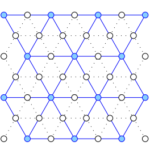
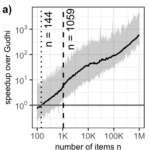
The data structure supports local operations, including the insertion and deletion of an item and the cutting and concatenating of lists, each in time O(log n + k), in which n is the number of critical items and k is the number of changes in the augmented persistence
diagram.
Published at SODA 2024
with Herbert Edelsbrunner, Monika Henzinger, Lara Ost

Based on persistent homology for images, kernels and cokernels, we design provably stable homological quantifiers that describe the geometric micro- and macro-structure of how the color classes mingle. These can be efficiently computed using chromatic variants of Delaunay mosaics and Alpha complexes.
Published at Foundations of Data Science (FoDS)
with Ondrej Draganov, Herbert Edelsbrunner, Morteza Saghafian
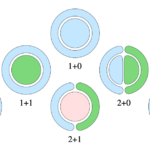
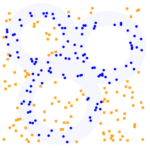
Delaunay mosaic in R^{s+d} that represents how points of different colors mingle. Our main results are bounds on the size of the chromatic Delaunay mosaic, in which we assume that d and s are constants.
For example, if A is finite with n = #A, and the coloring is random, then the chromatic Delaunay mosaic has O(n⌈d/2⌉ ) cells in expectation. In contrast, for Delone sets and Poisson point processes in R^d, the expected number of cells within a closed ball is only a constant times the number of points in this ball. Furthermore, in R^2 all colorings of a dense set of n points have chromatic Delaunay mosaics of size O(n). This encourages the use of chromatic Delaunay mosaics in applications.
Published at Journal of Discrete an Computational Geometry
with Ranita Biswas, Ondrej Draganov, Herbert Edelsbrunner, Morteza Saghafian
We prove Euler-type relations, which imply extensions of the classic Dehn-Sommerville relations for convex polytopes to sublevel sets of the depth function, and we use the relations to extend the expressions for the number of faces of neighborly polytopes to the number of cells of levels in neighborly arrangements.
Published at the Journal of Applied and Computational Topology, Special Issue: ATMCS10
with Ranita Biswas, Herbert Edelsbrunner, Morteza Saghafian

proofs of theorems about the symmetry of persistence diagrams and the variation of such maps. In particular, we identify branching points and endpoints of networks as the sole source of asymmetry and relate the cycle basis in persistent homology with a version of the stable marriage problem. Our analysis provides the foundations of fast algorithms for maintaining collections of interrelated sorted lists together with their persistence diagrams.
Published at the Journal of Applied and Computational Topology, Special Issue: Data Science on Graphs
with Ranita Biswas, Herbert Edelsbrunner, Morteza Saghafian

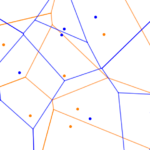
Delaunay mosaic can be defined by locally maximizing the negative power distance to other such points. We prove that the average of the two piecewise quadratic functions is piecewise linear, and that all three functions have the same critical points and values.
Discretizing the two piecewise quadratic functions, we get the alpha shapes as sublevel sets of the discrete function on the Delaunay mosaic, and analogous shapes as superlevel sets of the discrete function on the Voronoi tessellation. For the same non-critical value, the corresponding shapes are disjoint, separated by a narrow channel that contains no critical points but the entire level set of the piecewise linear function.
Published at the Journal of Discrete an Computational Geometry
with Ranita Biswas, Herbert Edelsbrunner, Morteza Saghafian
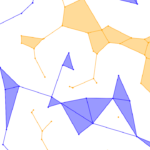
in terms of Morse theoretic quantities for piecewise constant functions on planar arrangements. Specifically, we prove that for a generic set of n ≥ 5 points in R3,the number of regions in the order-k Voronoi tessellation is Nk−1 –(k/2)n + n, for 1 ≤ k ≤ n − 1, in which Nk−1 is the sum of Euler characteristics of these function’s first k − 1 sublevel sets. We getsimilar expressions for the vertices, edges, and polygons of the order-k Voronoi tessellation.
Published at the 37th Symposium on Computational Geometry (SoCG)
with Ranita Biswas, Herbert Edelsbrunner, Morteza Saghafian